The official Newsletter of ASEACCU – The Association of Southeast and East Asian Catholic Colleges and Universities
Aseaccu Newsletter
August 2026
The Newsletter is published two times a year (Summer and Winter) by the Association of Southeast and East Asian Catholic College and Universities.
Dear Members and Friends of ASEACCU,
In these bright months of the Jubilee Year of Saint Francis of Assissi, our region is again invited to stand at the service of communion and dialogue. The Federation of Asian Bishops’ Conferences gathered in Jakarta, calling the Church in Asia to be bridge-builders rooted in synodality and friendship across cultures and faiths. Pope Leo XIV has urged the academic community to form leaders who serve the common good with integrity, to resist superficiality in the digital age and to hold together truth, freedom and solidarity. His encyclical Magnifica humanitas reminds us that artificial intelligence and every new tool of our time must be directed by conscience toward human dignity. This Summer Edition arrives as a shared witness to that vision: Catholic universities in our association are linking scholarship and service, prayer and public life, with a hope that is as rigorous as it is compassionate.
International ties remain a sign of our common purpose. The University of St. La Salle deepened a scientific partnership through its first laboratory assistantship at Tokyo Metropolitan University, giving Materials Engineering students meaningful research practice and cultural learning. Saint Louis College of San Fernando welcomed delegates to the inaugural Synergia International Research Conference, where participants strengthened research cultures and signed new agreements for cooperation. The University of Negros Occidental Recoletos brought its leadership to Taiwan for the HLU Conference and the WURI ceremony, sealing fresh memoranda with regional partners. Holy Name University opened the year by convening the Topology and Algebras Workshop Philippines 2026 and launched an international mentorship strand for young scholars. In Rome, the International Association of Lasallian Universities gathered leaders from the University of St. La Salle for mission-centred formation, including a conversation with Cardinal José Tolentino de Mendonça on the ethical shape of AI. Seeking new avenues for exchange, the University of Saint Joseph’s Vice-Rector for Academic Affairs and Internationalisation visited CHRIST and Kristu Jayanti University in Bangalore to align plans for student mobility and joint research, while also inviting them to the 32nd ASEACCU Conference. These campus-level actions echo IFCU’s global report on internationalisation in Catholic higher education, which calls for partnerships ordered to dialogue and the common good, and they meet the spirit of IFCU’s Concordia Initiative that places academic diplomacy at the service of peace and policy engagement.
Across our network, ethical research is in steady conversation with human flourishing. Universitas Katolik Widya Mandala Surabaya, with AFTI, convened an international symposium on humanity, justice and ecological schemes, including reflections on AI and contemplative care for the oceans, and a proposal that read Hans Jonas with local wisdom on plant life. The same university, with Cardiff University and Edinburgh Napier University through British Council support, shared global findings on barriers faced by disabled students and launched the Sahabat-ID campaign shaped by the Social Model of Disability. The University of Saint Joseph inaugurated Bibliotheca Diocesis Macaonensis with the University of Minho, a digital humanities project that draws on AI, big data and machine learning to study the history of the Diocese of Macau and Catholic missions in Asia. Australian Catholic University released Maps of Hope in collaboration with the Dicastery for Culture and Education, gathering Pope Leo XIV’s earlier reflections on education and AI that now stand beside Magnifica humanitas. ACU also joined Universitas Gadjah Mada to launch the Indonesia–Australia Human Flourishing Centre for collaborative research and joint doctoral pathways on health, justice, interfaith relations, education and integral ecology, while strengthening philosophical reflection through the Ray L. Hart Centre for Philosophy of Religion under its inaugural director, Professor Garth Green. At the international level, IFCU’s Foresight Unit began AI Watch, a monthly brief that keeps Catholic universities attentive to developments and questions in technology and work, always with a human centred lens.
Our identity is renewed in worship, formation and memory. In Macao, the University of Saint Joseph and the Diocese concluded a year-long professional training programme for religious education teachers at a closing Mass, underlining the link between pedagogy and discipleship. The University of Negros Occidental–Recoletos celebrated with four Augustinian Recollect priests the 33rd anniversary of their Simple Profession, a humble reminder that consecrated life remains a living school of service. St. Paul University Manila gathered the community to remember the Battle of Manila with prayer and civic solidarity, ensuring that historical wounds become occasions for conscience. Holy Name University dedicated the Immaculate Spouse of the Holy Spirit Church, a beautiful triangular space that welcomes liturgy and formation at the heart of campus life. USJ’s commemoration of the 800th anniversary of the death of St Francis of Assisi drew together theology and art in a lecture on Franciscan spirituality and the Basilica’s frescoes. The Church’s wider narrative has also been shared through Vatican News’ documentary Leone a Roma, which traces the life of Pope Leo XIV in the city where his ministry of teaching and friendship matured.
Culture and public dialogue are flourishing through the arts. Assumption College hosted the 21st Pinoy Media Congress, bringing students and professionals into conversation about content creation, communication ethics and a changing media environment. Soegijapranata Catholic University stood with many groups in Semarang’s Interfaith Art and Cultural Carnival, giving public expression to friendship across religions. SCU’s Teater Anting staged the musical Bunsu Rusa to introduce international students to Kalimantan’s Iban Dayak culture, complete with traditional skills such as jamu preparation. St. Paul University Manila’s Kantiyawan celebrated Original Pinoy Music and cinema through a joyful student production, while the university also blessed and inaugurated a restored pipe organ by Diego Cera Organbuilders for liturgical use and formation in sacred music. Charity and art met on stage at SPU Manila’s Move It, Groove It to P-Pop, where young dancers raised funds for those in need. SCU’s Gratia Choir carried Indonesia’s name to the European Grand Prix Grand Final in Maribor and then sang in Vienna, offering excellence as a form of witness. Widya Mandira Catholic University’s Chrono-Comm Collective won honours at the Kavinya Film Festival for One Click, a student film that prompted careful reflection on the human costs of social media.
Service for the common good remains the heartbeat of our campuses. Universitas Atma Jaya Yogyakarta, working with the University of Huddersfield, IRGSC and SOPAN Sumba, held a workshop in Waingapu that strengthened the voices of indigenous women on climate challenges and secured a commitment from local government to include their representatives in development planning. UAJY students also travelled to Bulacan with Bulacan State University for international community service, co-designing eco-enzyme processing, maggot farming and a materials recovery facility, and forming local volunteers in waste reduction. Assumption College’s NSTP students brought disaster preparedness to Grade 5 pupils in Pasay City through peer-led sessions on go-bags, fire safety and earthquake evacuation. In Maumere, a UAJY law alumna, Sister Ika, coordinated with police and humanitarian partners to rescue 13 women from trafficking, placing protection and prevention at the centre. Looking to the future of schools, St. Paul University Manila announced scholarships for new Education majors in Science and Mathematics, with PEAC–Rex Edukasyon support, to help address national learning gaps.
We rejoice in the growth of our students and alumni. The University of Negros Occidental–Recoletos marked the first TESDA Bread and Pastry Production NC II graduation of its STEP initiative, pairing gratitude at Mass with practical starter toolkits for new bakers. A University of the Immaculate Conception student in Pharmacy and Chemistry placed in the top seven per cent worldwide with a Silver Honour at the International Chemistry Competition. Three Computer Engineering students from the University of San Carlos won Best Overall Project in the Engineering Innovation Challenge with a blueprint for safer and smarter public transport. USC’s IMA student chapter became the first from the Asia–Pacific to receive the Clark Johnson Award and achieved a third consecutive Gold Award of Excellence. The University of St. La Salle placed sixth nationally in the Chemical Engineering Licensure Examination, welcoming eight new engineers. USC Law reached the International Rounds quarterfinals of the Jessup Moot, with one oralist among the top fifty. From Widya Mandira Catholic University, Julian Mukin earned second place for Best Digital Innovation at the IYIS Malaysia and Singapore Summit with Wasteback, a creative approach to community recycling. At the and now serves University of Santo Tomas Legazpi, Mae Angela D. Locsin placed 16th in the Bar Examinations the public as a State Auditor, while Noeh Francheska D. Arnaldo ranked seventh in the Nurses Licensure Examination and Yvonne Mae C. Cabrera placed eighth in the Psychometrician Licensure Examination. Across disciplines, these achievements speak of vocation, perseverance and social purpose.
Quality assurance and institutional contribution round out this issue’s news. UNO-R received multiple honours at CHED’s 2nd Regional Quality Awards for internationalisation, student affairs, programme performance and the effective use of data systems, together with recognition in WURI. The University of the Immaculate Conception formally joined the UN Sustainable Development Solutions Network, aligning curriculum, research and community action with the SDGs, and rose in the WURI Global Top 500, including top placements in SDG and entrepreneurship categories. Holy Name University secured 337th place in WURI with thirteen entries in Top 100 areas, highlighting practices that link innovation with social impact. The University of St. La Salle attained AUN-QA certification for three programmes in Marketing Management, Nursing and Biology, a sign of steady attention to student learning and continuous improvement.
Taken together, these stories show Catholic universities at their best: building bridges across borders, thinking carefully about technology and ethics, drawing deeply from prayer and memory, and sending students into the world with competence and compassion. As we prepare to gather for the 32nd ASEACCU Conference in Indonesia this August, let us recommit ourselves to education that honours human dignity, strengthens peace and keeps faith at the centre of academic life. May the Holy Spirit guide our shared work in these Jubilee days, and may our communities be places where the joy of the Gospel shapes minds and hearts.
In solidarity and prayer,
The ASEACCU Secretariat University of Saint Joseph Macao
ASEACCU Activities & Events
Nothing Found
It seems we can’t find what you’re looking for. Perhaps searching can help.
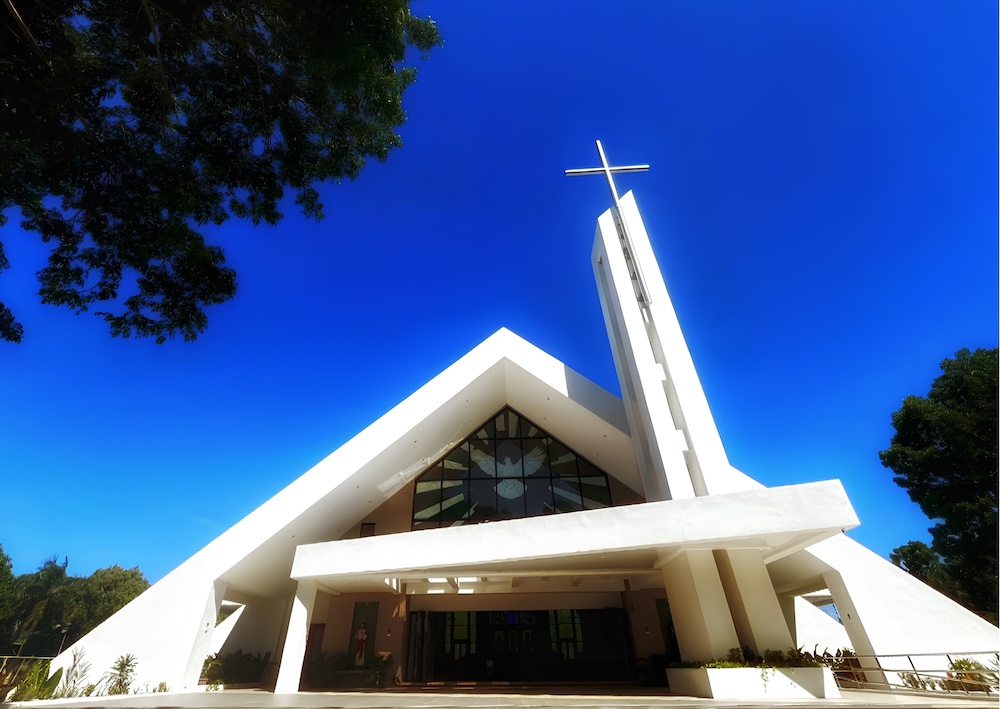
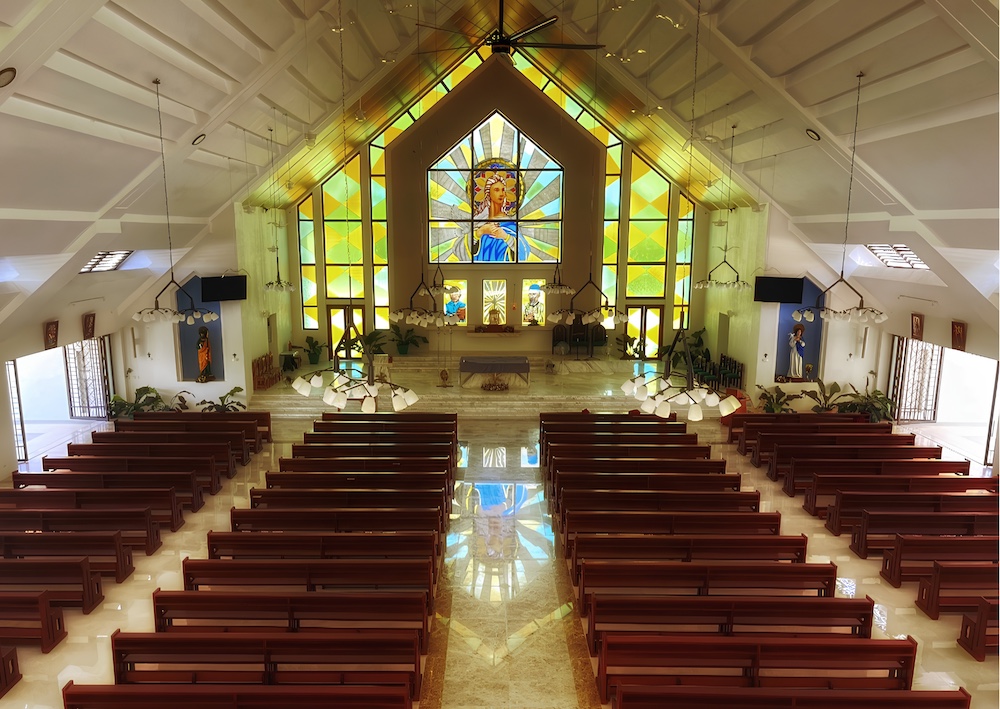
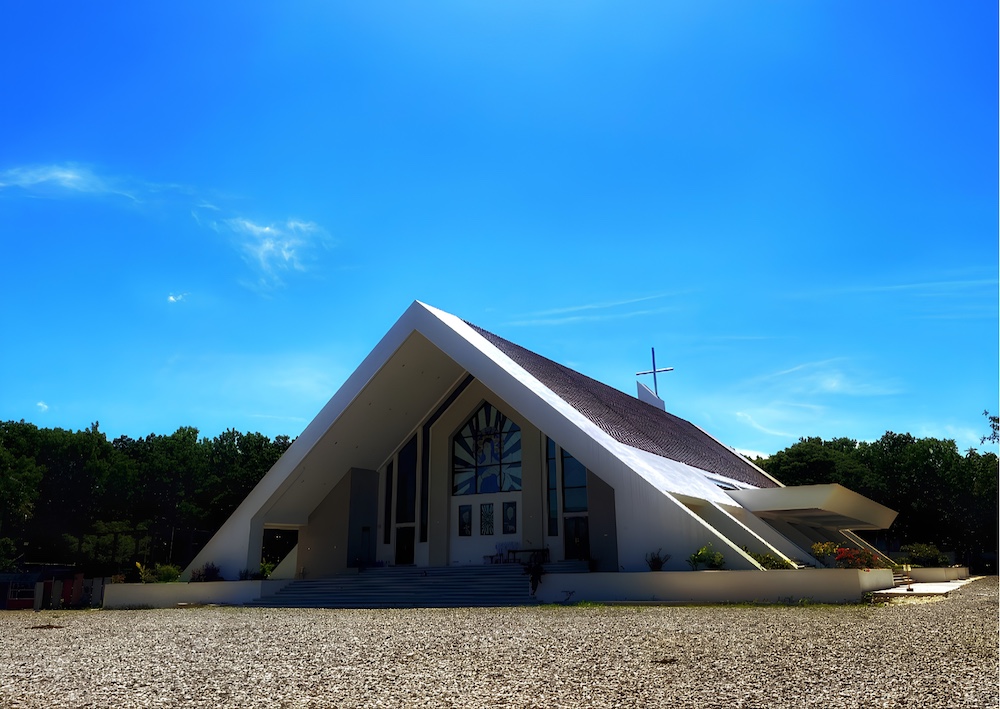
Holy Name University commemorated the 150th Anniversary of the Society of the Divine Word (SVD) and honored the birth anniversary of its founder, St. Arnold Janssen, through the solemn dedication of the Immaculate Spouse of the Holy Spirit Church. The church stands as a visible expression of the university’s commitment to nurturing faith.
“Vivat Deus Unus et Trinus in Cordibus Nostris”
The Symbolic Structure: Rooted in the Trinity
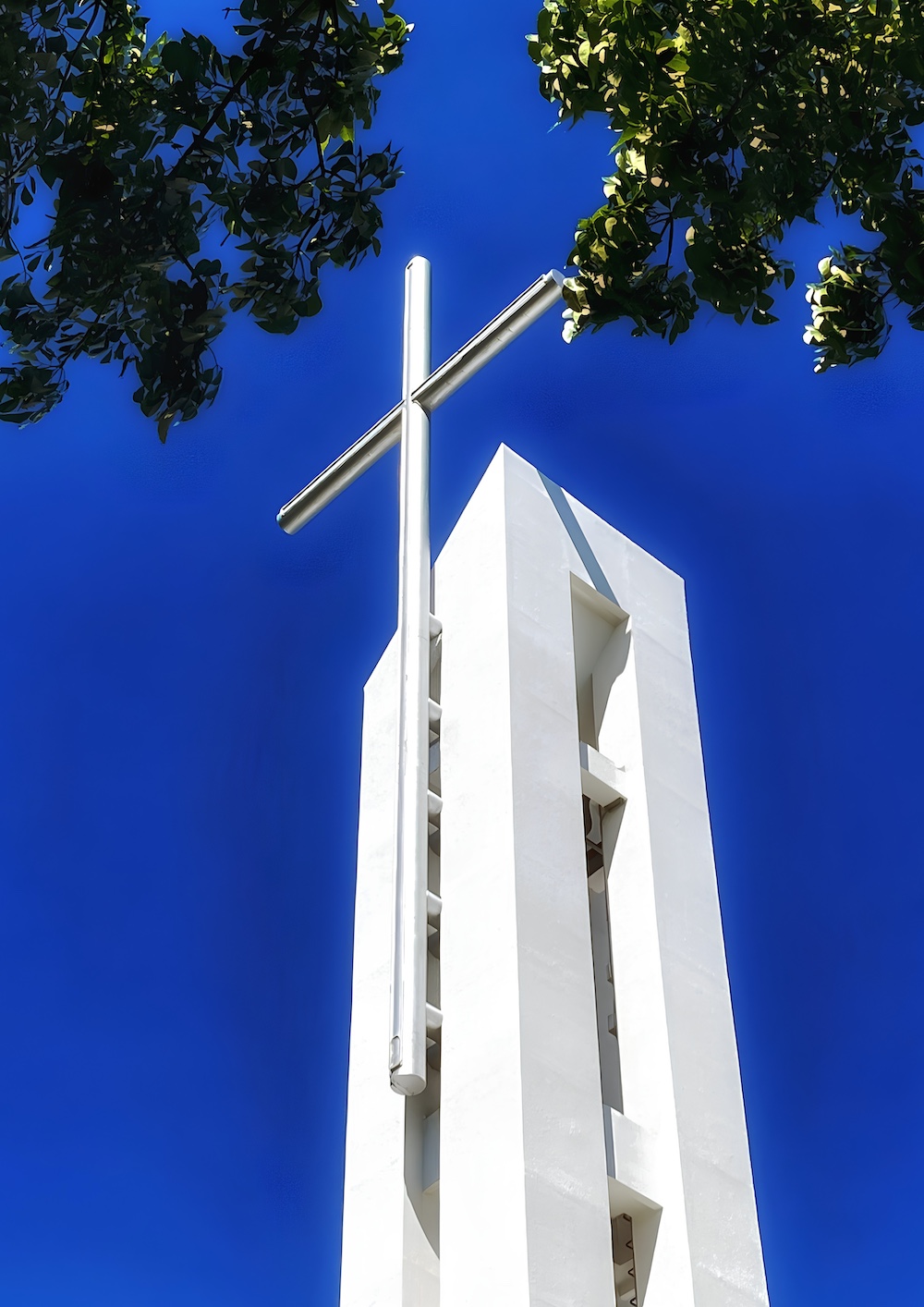
The church's triangular form is a symbol of the Holy Trinity, which was at the heart of the spirituality of St. Arnold Janssen. The mystery of the Holy Trinity was expressed through the triangular form of the building. The three sides of the triangle represent the Father, the Son, and the Holy Spirit. Just as the three sides of a triangle are inseparable and form one figure, the Triune God invites all people into a communion of love and unity. The upward point of the triangle also reminds us that our lives and mission are directed to the Father who is the principal rest of the Blessed Trinity to whom all are to return.
Beyond its symbolism, the architect intended the structure itself to become an expression of prayer. The church's triangular form creates the silhouette of a person's arms and hands clasped in prayer, transforming the building into a quiet gesture of worship that welcomes every person who enters.
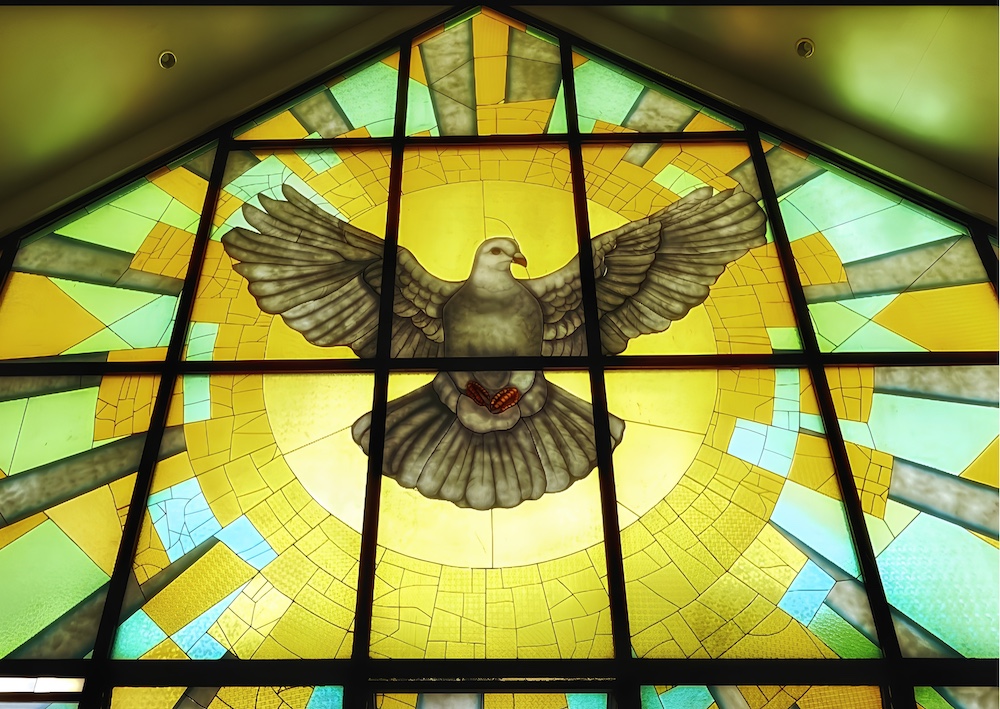
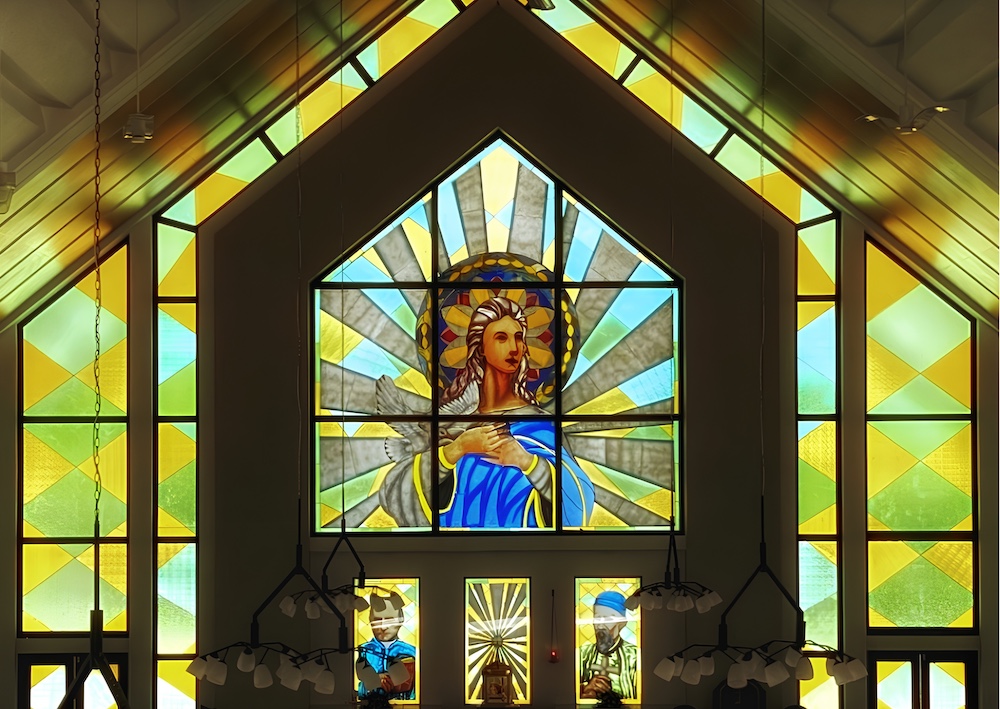
In the stained glass above the nave, the Holy Spirit appears as a dove hovering over those gathered in prayer, a quiet sign of God’s nearness and promise fulfilled. Like the dove sent out by Noah; first returning in patient waiting, then bearing an olive branch of peace, and finally going forth in the renewed world, becomes a symbol of hopeful expectation and answered promise. The Holy Spirit is not distant or abstract but rests upon God’s people, the same way He descended upon Christ and remained. When Scripture says the Spirit came “like a dove”, it is not trying to describe what the spirit looked like, but how He came: in a way that brings rest and assurance. From above the sanctuary, this image gathers the faithful beneath a living assurance: God is with you, and His presence remains.
The symbolism of the church is matched by its architectural experience. The architect noted that the diagonal lines create a sense of movement that signifies continuity and hope in all aspects of life. This vision is carried through the church's expansive interior, where natural light, open spaces, and unobstructed sightlines create what he described as a dignified and welcoming space conducive to prayer and liturgical celebrations.
"We hope to have achieved a sense of timelessness in the design of the church. This is the church of our time, built with the same devotion, reverence, and quiet grandeur of the past, with design elements that resonate with a modern generation."
- Ar. Rodolfo P. Ventura, MSc, FPIA, Principal Architect, C.A. Ventura and Partners; Dean, University of Santo Tomas College of Architecture
The Holy Spirit and the Immaculate Heart of Mary
The name Immaculate Spouse of the Holy Spirit embodies the relationship between the Blessed Virgin Mary and the Holy Spirit in the mystery of salvation. Her response to God's call "Behold, I am the handmaid of the Lord; let it be done to me according to your word" (Luke 1:38).
Mary, as the Immaculate Spouse of the Holy Spirit, holds a unique place within the mystery of the Most Holy Trinity, for her Immaculate Heart is completely united with the divine will of the Father, the Son, and of the Holy Spirit. Through the Holy Spirit, she was filled with grace and made the perfect dwelling place of God, and in her maternal love she continues to lead souls into deeper communion with the Triune God.
In calling upon Mary, we are never separated from the Holy Spirit, for her whole being is formed and moved by Him who entrusted to her the distribution of graces according to God’s will. Thus, the Immaculate Heart of Mary becomes a pathway to the Holy Trinity, drawing us to the Father as our ultimate fulfillment, to the Son as our Redeemer, and the Holy Spirit as the source of all sanctification; so that, through her, we may be transformed into living reflections of divine love.
Ad Finem
Since its dedication, the Immaculate Spouse of the Holy Spirit Church has become a sacred center of worship, reflection, and community life. It serves as a gathering place where students, faculty, staff, alumni, and visitors come together for prayer, liturgical celebrations, and spiritual reflection. Daily Masses are celebrated from Monday to Saturday at 12:00 noon, while Sunday Mass is held at 10:30 a.m., providing regular opportunities for communal worship and faith formation. The Sacrament of Reconciliation is available 30 minutes before the daily 12:00 noon Mass, from Monday to Saturday.
As a sacred dwelling of prayer and grace, the Immaculate Spouse of the Holy Spirit Church stands as a reminder of God’s presence among His people. Rooted in the mystery of the Most Holy Trinity and under the patronage of Mary, the Immaculate Spouse of the Holy Spirit, it invites all who enter to grow in faith, prayer, and communion with God.
In Deum
Throughout the academic year, Holy Name University offers recollections for both Integrated Basic Education Department (IBED) and tertiary students, providing opportunities for reflection, discernment, and spiritual growth. Retreat programs for graduating students help them prepare for the next stage of life while carrying forward the values and formation they have received at the university.
Faculty and staff are likewise encouraged to deepen their faith through the annual Employees’ Retreat and other formation programs. Initiatives such as the Arnold Janssen Spirituality Seminar foster a deeper appreciation of the life, mission, and spirituality of St. Arnold Janssen, Father and founder of the Society of the Divine Word. Advent and Lenten Recollection are likewise introduced to all employees to keep them abreast to the liturgical seasons.
The church also serves as a venue for community building activities, including One University in Prayer and Worship Fest, which promote unity and active participation among students and the wider university community.
Looking ahead, Holy Name University will host the National Conference on Catechesis and Religious Education (NCCRE) in April 2027, bringing together educators, catechists, and faith leaders from across the country and further strengthening the university’s commitment to religious education, evangelization, and faith formation.
From moments of prayer and worship to formation programs, outreach initiatives, and national gatherings, every undertaking reflects Holy Name University's commitment to LOVE; Liturgical Activities, Organizational Outreach, Vocation Animation Activities, and Educational Pastoral, forming a university community rooted in faith, inspired by mission, and dedicated to serving God and others.
"
["post_title"]=>
string(160) "Holy Name University Commemorates the 150th Anniversary of the Society of the Divine Word with the Dedication of the Immaculate Spouse of the Holy Spirit Church"
["post_excerpt"]=>
string(0) ""
["post_status"]=>
string(7) "publish"
["comment_status"]=>
string(6) "closed"
["ping_status"]=>
string(6) "closed"
["post_password"]=>
string(0) ""
["post_name"]=>
string(160) "holy-name-university-commemorates-the-150th-anniversary-of-the-society-of-the-divine-word-with-the-dedication-of-the-immaculate-spouse-of-the-holy-spirit-church"
["to_ping"]=>
string(0) ""
["pinged"]=>
string(0) ""
["post_modified"]=>
string(19) "2026-08-11 16:09:50"
["post_modified_gmt"]=>
string(19) "2026-08-11 08:09:50"
["post_content_filtered"]=>
string(0) ""
["post_parent"]=>
int(0)
["guid"]=>
string(39) "https://newsletter.aseaccu.asia/?p=2430"
["menu_order"]=>
int(0)
["post_type"]=>
string(4) "post"
["post_mime_type"]=>
string(0) ""
["comment_count"]=>
string(1) "0"
["filter"]=>
string(3) "raw"
}
[1]=>
object(WP_Post)#15140 (24) {
["ID"]=>
int(2402)
["post_author"]=>
string(1) "2"
["post_date"]=>
string(19) "2026-08-11 13:22:46"
["post_date_gmt"]=>
string(19) "2026-08-11 05:22:46"
["post_content"]=>
string(6929) "
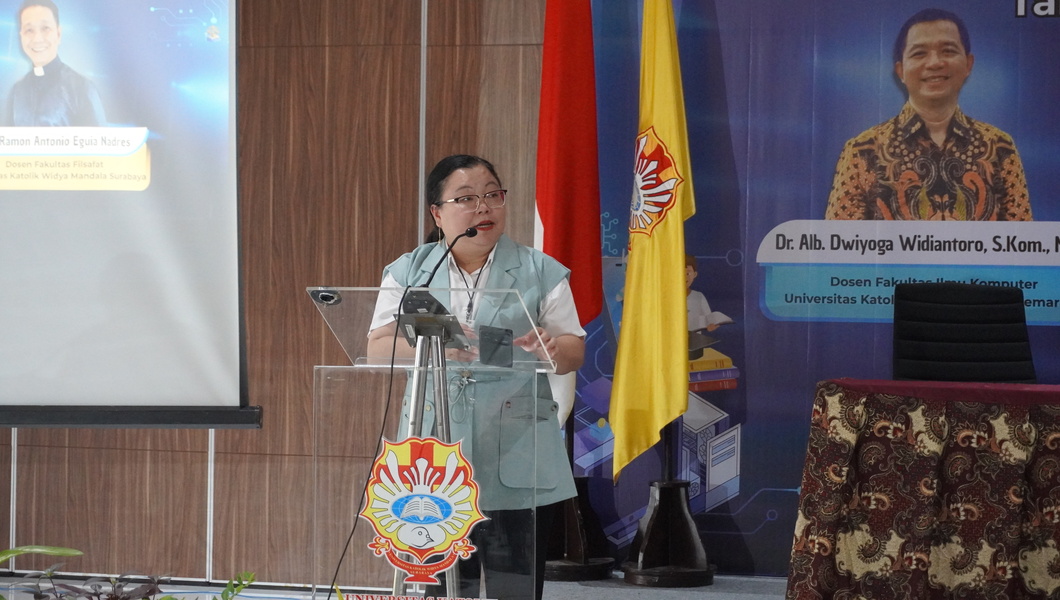
Aloysius Widyawan as the Chair of LPNU UKWMS, delivering his opening remarks (Documentation: PKP UKWMS)
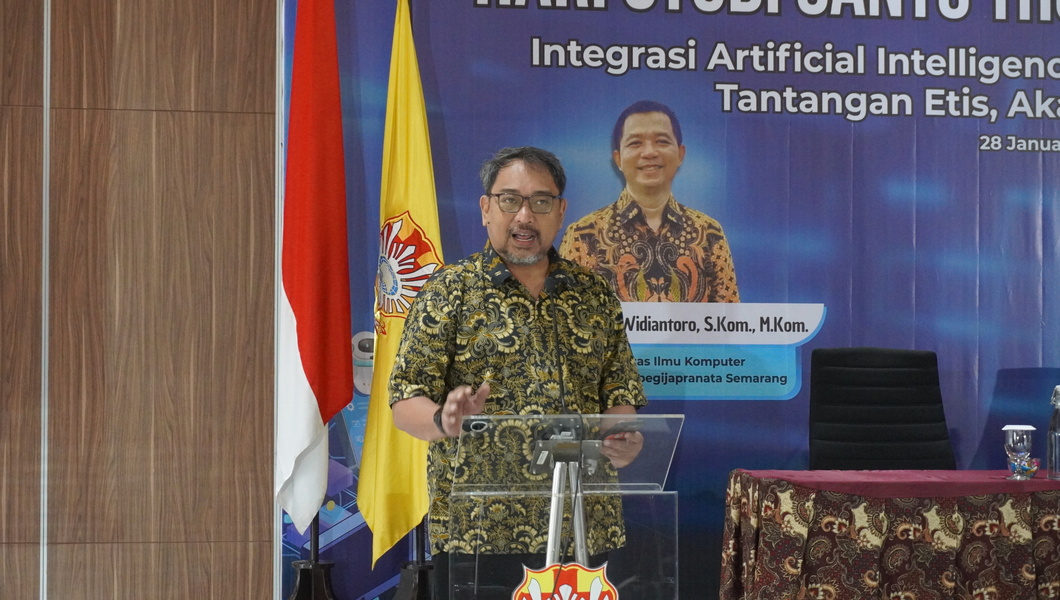
Universitas Katolik Widya Mandala Surabaya (UKWMS) had once again reaffirmed its commitment to addressing the challenges of technological advancement. The effort took form when UKWMS was hosting the 2026 St. Thomas Aquinas Study Day, with “Integrating Artificial Intelligence into Higher Education: Ethical, Academic, and Moral Challenges” as its theme. The event took place on Wednesday, 28 January 2026, in Widya Manggala Room at UKWMS Pakuwon City Campus.
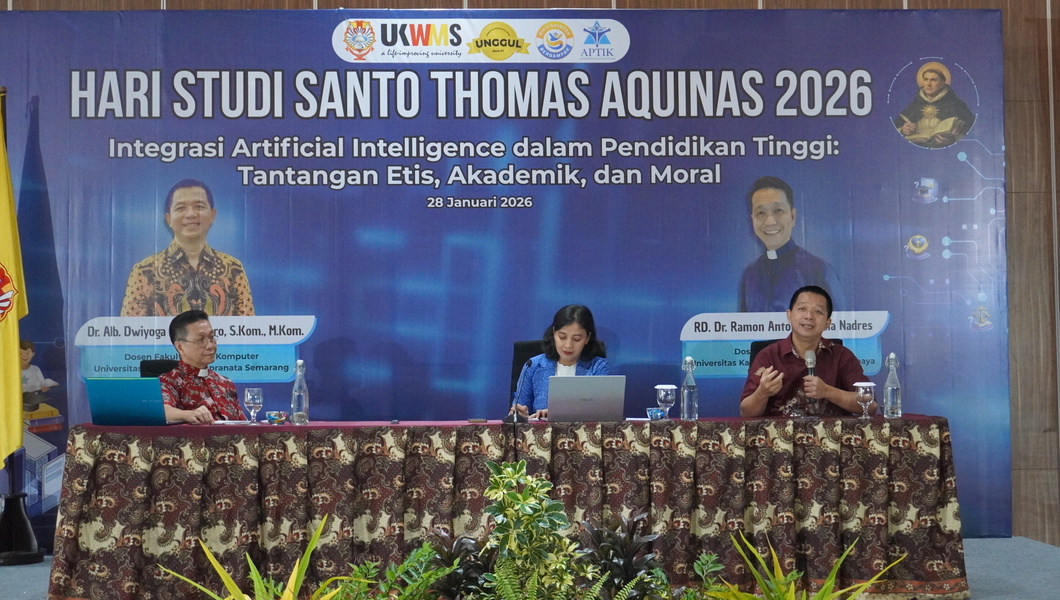
The event featured speakers from various fields of information technology, philosophy, and theology, ensuring a comprehensive discussion ranging from technical to moral perspectives. The speakers were Dr. Alb. Dwiyoga Widiantoro, S.Kom., M.Kom., a lecturer from the Faculty of Computer Science of Soegijapranata Catholic University, Indonesia, and Rev. Dr. Ramon Antonio Eguia Nadres, a lecturer from the Faculty of Philosophy of UKWMS.
This annual academic forum was organized by the Institute for the University Values Strengthening Institute of UKWMS. The event was attended by deans, faculty leaders, heads of study programs, representative lecturers, and heads of work units within UKWMS Surabaya and Madiun, as well as lecturers from the Association of Catholic Higher Education Institutions (APTIK).
The Head of LPNU UKWMS, Dr. Aloysius Widyawan, stated that the development of Artificial Intelligence (AI), particularly generative AI, has brought major changes to the world of higher education. "AI provides great opportunities in learning, research, and administration. On the other hand, it also presents serious challenges related to ethics, academic integrity, and human values," he said.
Through the 2026 St. Thomas Aquinas Study Day, UKWMS invited lecturers and academic leaders to understand the latest developments in AI technology, identify its benefits and risks, and formulate attitudes and guidelines for its wise and responsible use.
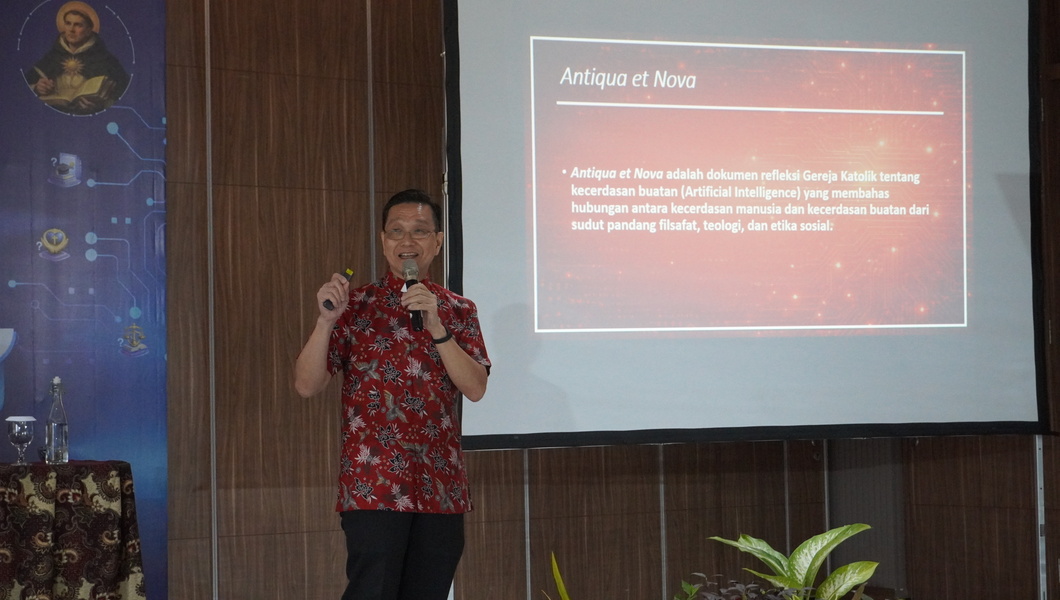
"AI has currently undergone significant development and is becoming increasingly widespread. Even without human intervention, AI can operate and generate the materials we need. However, it becomes a challenge for us not to depend entirely on AI; instead, we must make AI 'tired' with the narratives or commands we provide," said Yoga—as Dwiyoga is familiarly called.
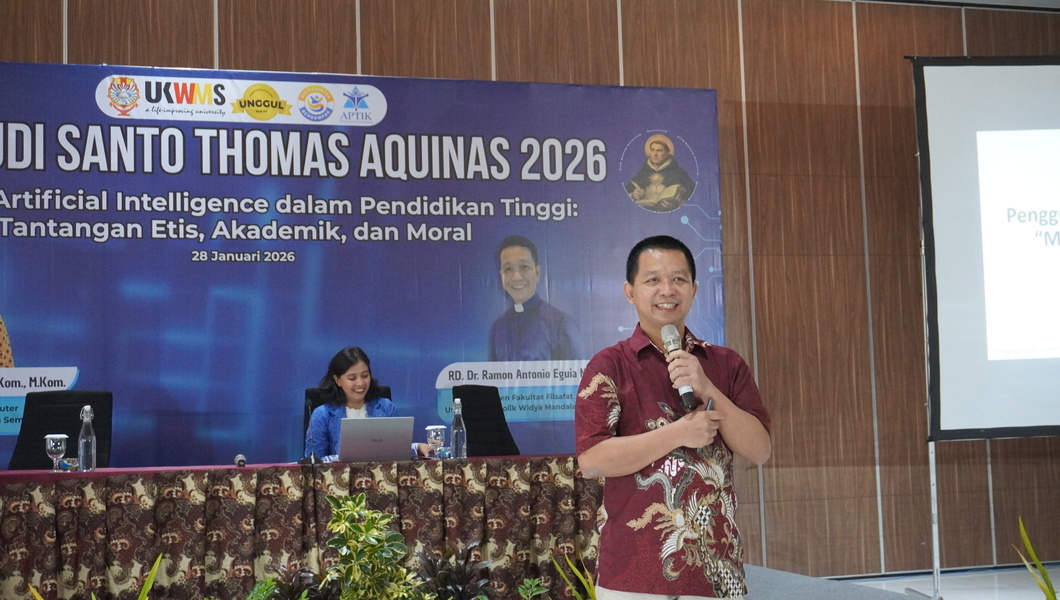
Dwiyoga Widiantoro, the first speaker for the 2026 Saint Thomas Aquinas Study Day at UKWMS
Besides the challenges, there are ethics and morals that must be considered when using AI. "As lecturers, we must be able to guide our students, teach ethics, and use AI wisely in accordance with morals. AI will never become human, because human intelligence has an embodiment," explained Father Ramon.
Ramon Antonio Eguia Nadres, the second speaker for the 2026 Saint Thomas Aquinas Study Day at UKWMS Left to right: Ramon Antonio, Luisa Hartanti as the moderator and Dwiyoga Widiantoro during the discussion session
UKWMS Stance on AI
Both speakers agreed that all educational institutions—including UKWMS—cannot avoid facing the onslaught of AI. AI however, is not a replacement for humans, but rather a tool for information and performance support. Undeniably, AI also has its limitations. And we, as humans must also be able to keep up.
The Rector of UKWMS, apt. Sumi Wijaya, S.Si., Ph.D., emphasized that the integration of AI on campus must always be aligned with Catholic values, which uphold human dignity, truth, and moral responsibility. "Technology must serve as a means for holistic human development, not replace human roles and values. We must also be able to utilize AI effectively," she stressed.
UKWMS also hopes to be a trailblazer in developing ethical, humanistic, and value-based AI utilization policies in higher education. The 2026 St. Thomas Aquinas Study Day serves as a collective space for shared reflection to deliver creative, innovative, and morally grounded higher education in the digital age.
Dr. Sumi Wijaya as the Rector of UKWMS delivered a statement on UKWMS stance regarding the development of AI
"
["post_title"]=>
string(49) "UKWMS Hosts the 2026 St. Thomas Aquinas Study Day"
["post_excerpt"]=>
string(0) ""
["post_status"]=>
string(7) "publish"
["comment_status"]=>
string(6) "closed"
["ping_status"]=>
string(6) "closed"
["post_password"]=>
string(0) ""
["post_name"]=>
string(48) "ukwms-hosts-the-2026-st-thomas-aquinas-study-day"
["to_ping"]=>
string(0) ""
["pinged"]=>
string(0) ""
["post_modified"]=>
string(19) "2026-08-11 13:22:48"
["post_modified_gmt"]=>
string(19) "2026-08-11 05:22:48"
["post_content_filtered"]=>
string(0) ""
["post_parent"]=>
int(0)
["guid"]=>
string(39) "https://newsletter.aseaccu.asia/?p=2402"
["menu_order"]=>
int(0)
["post_type"]=>
string(4) "post"
["post_mime_type"]=>
string(0) ""
["comment_count"]=>
string(1) "0"
["filter"]=>
string(3) "raw"
}
[2]=>
object(WP_Post)#15144 (24) {
["ID"]=>
int(2342)
["post_author"]=>
string(1) "2"
["post_date"]=>
string(19) "2026-07-03 11:51:00"
["post_date_gmt"]=>
string(19) "2026-07-03 03:51:00"
["post_content"]=>
string(2724) "
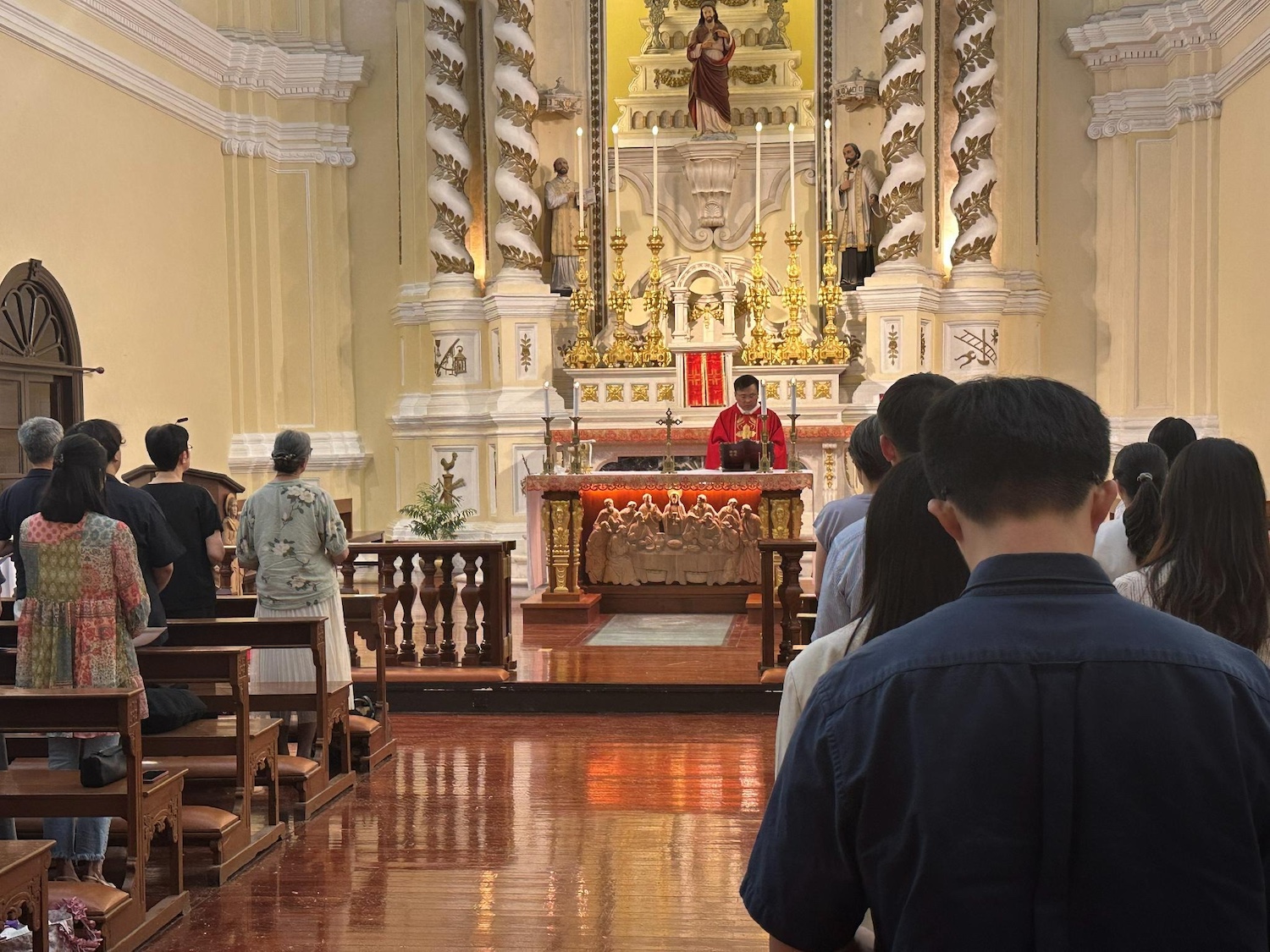
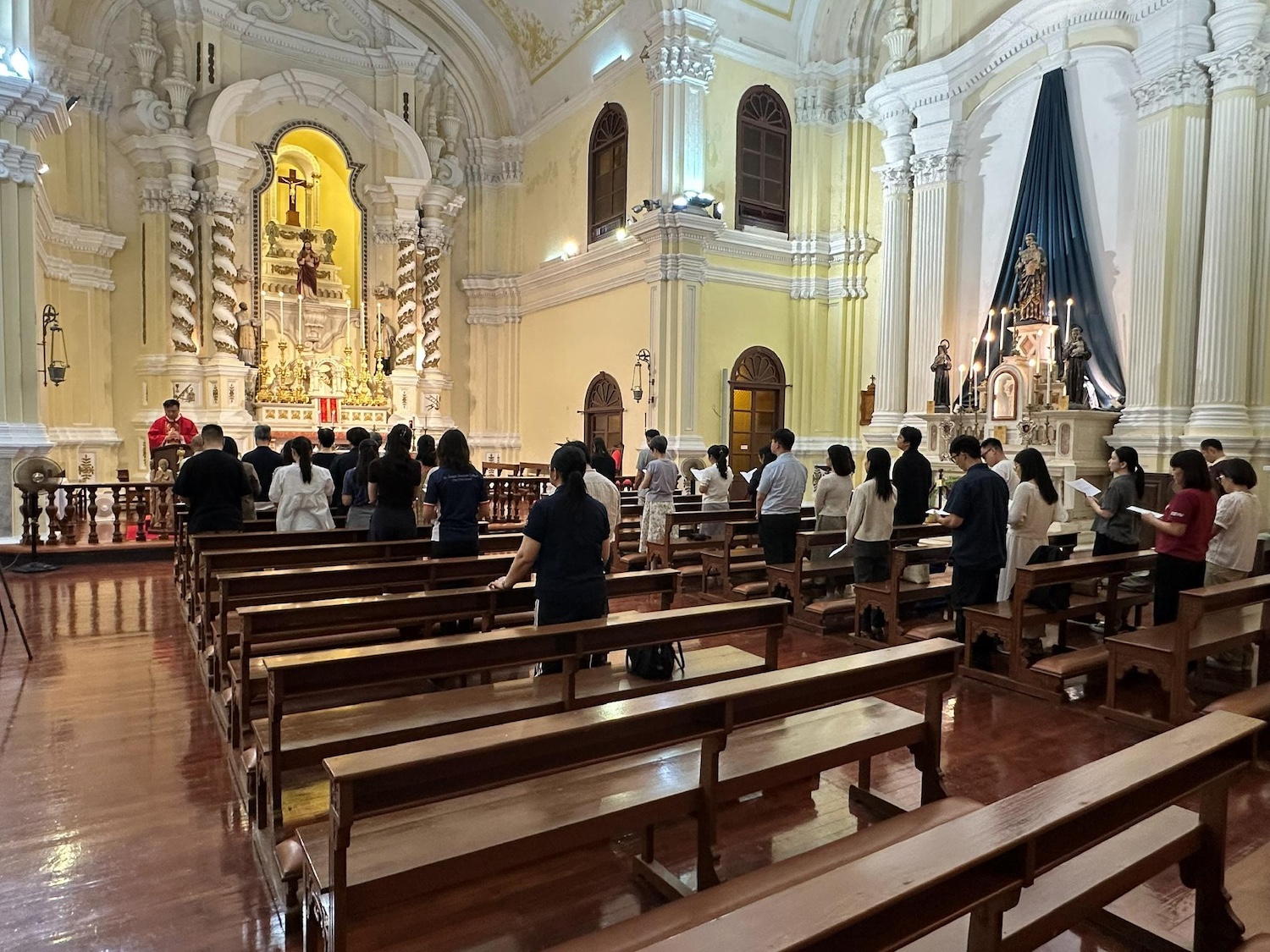
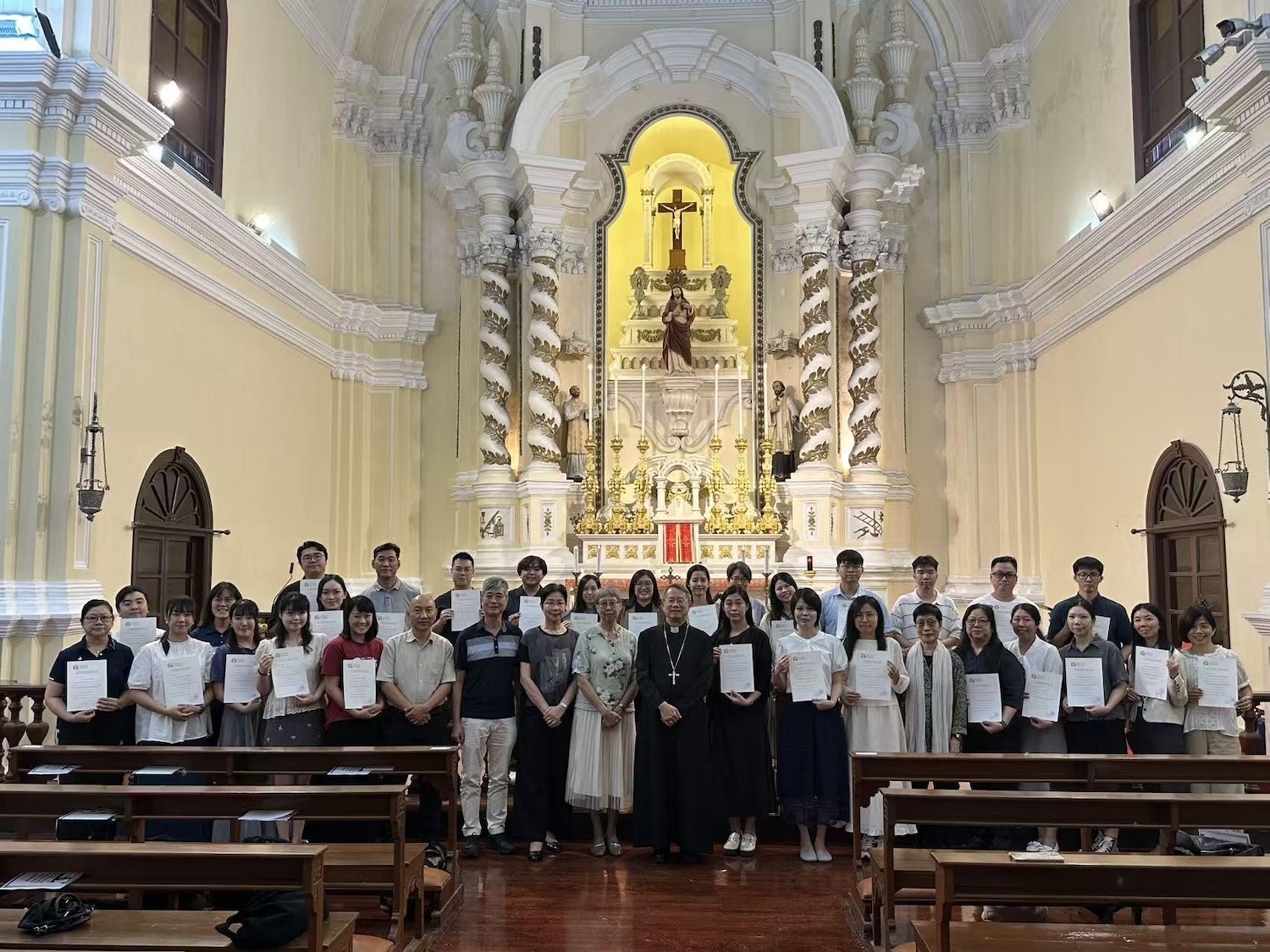
The Catholic Diocese of Macao and the University of Saint Joseph (USJ) once again co-organised the “Professional Training Program for Religious Education Teachers” during the 2025–2026 academic year, which has now concluded successfully. The programme aimed to cultivate proper doctrinal understanding and professional teaching proficiency among religious education teachers.
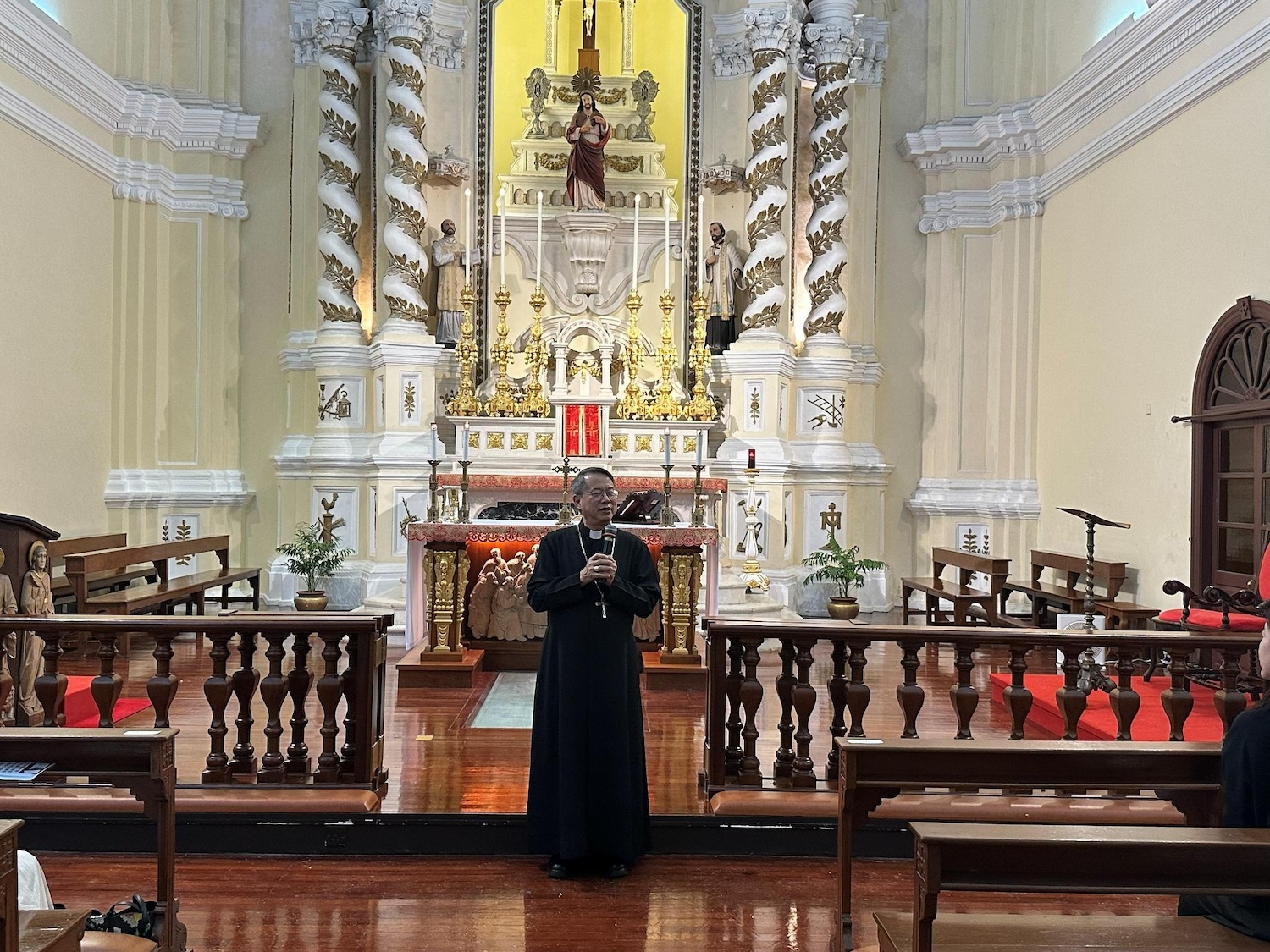
The closing Mass was held on July 3, 2026, celebrated by Father Cyril Law, Secretary General of the Catholic Diocese of Macao and Dean of the Faculty of Religious Studies and Philosophy at the University of Saint Joseph. His Excellency, Bishop Stephen Lee Bun-Sang of the Catholic Diocese of Macao presented the certificates to the participants. A total of thirty participants completed this training programme and received their certificates.
Through the Eucharistic celebration, the participants were inspired to spread the message of the Gospel through religious education and to manifest God’s sovereignty.
In closing, the Bishop Stephen Lee Bun-Sang encouraged the teachers, emphasising that as religious education teachers, their role is not merely to convey religious knowledge to students, but to use the content of the subject to lead students to an encounter with Christ.
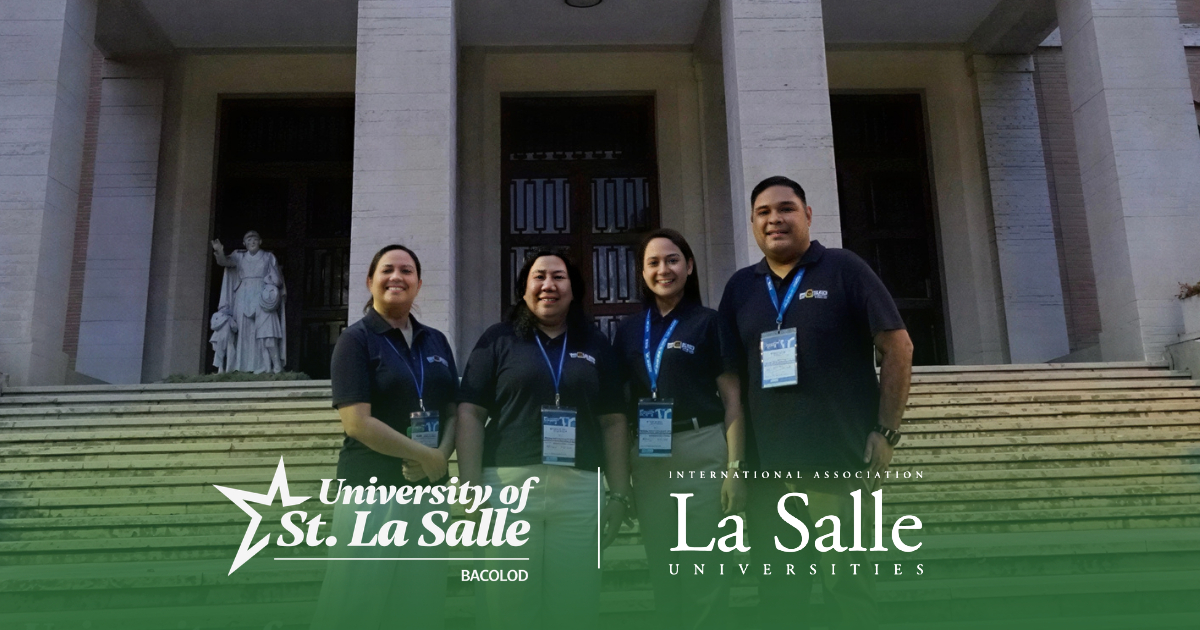
Leaders from the University of St. La Salle (USLS) recently joined the 2026 Rome Program of the International Association of Lasallian Universities (IALU), a leadership formation initiative that brought together Lasallian educators and administrators from around the world. Held in Rome, the program focused on leadership, mission, and the changing role of Catholic and Lasallian education.
Representing the University was University Chancellor, Minnie O. Chua, Vice Chancellor for Mission and Development, Mark Christopher Dueñas, Assistant Vice Chancellor for Academic Affairs, Dr. Toni-An Lachica and Executive Assistant to the President, Jennifer Yulo.
Their participation reflects the University’s continued investment in leadership formation and stronger ties within the global Lasallian network.
A key moment in the program was an audience with Cardinal José Tolentino de Mendonça at the Vatican’s Dicastery for Culture and Education. During the discussion, he encouraged universities to be spaces for critical thinking and reminded participants that developments in artificial intelligence must remain grounded in ethics, human dignity, and the common good.
Organized by IALU, the Rome Program gives Lasallian institutions a space to share ideas, learn from one another, and respond to challenges facing education today.
For the University, participating in the program strengthens its connection to the wider Lasallian community and supports the formation of leaders grounded in mission and service.
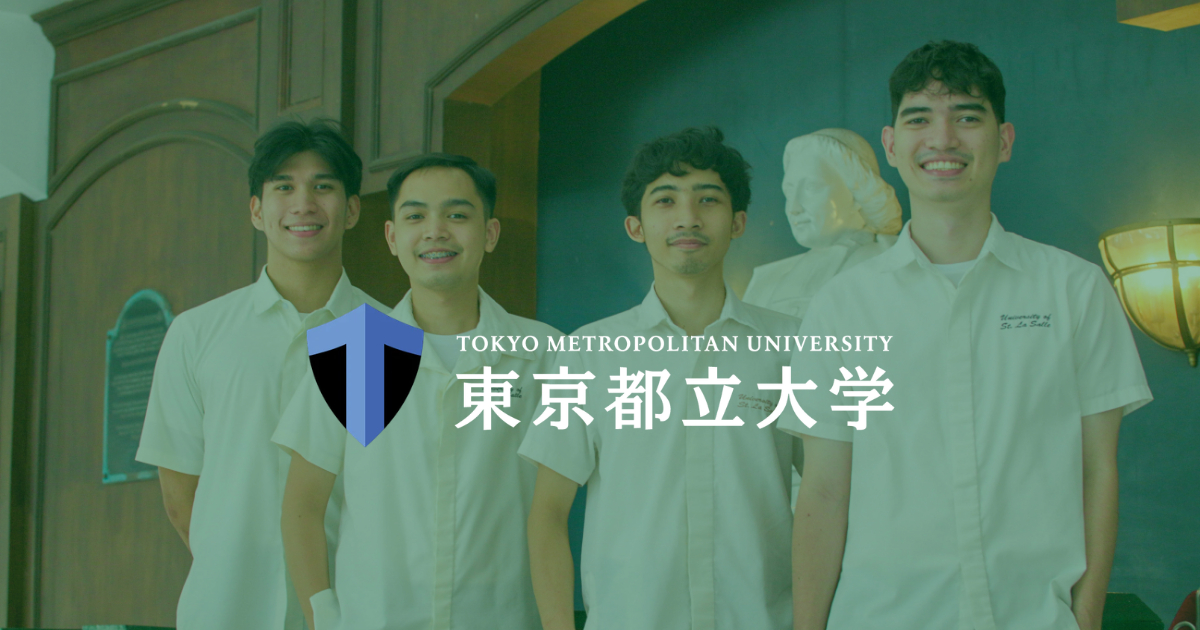
The University’s first-ever international laboratory exposure program officially begins as four Materials Engineering students from the College of Engineering undertake a laboratory assistantship at Tokyo Metropolitan University from May 16 to 26.
The pioneering program places the participating students, Jahmai Mar Alarcon, Jasper Graf, Sean Irvin Nolasco, and Emmanuel Salgado, under the Department of Civil and Environmental Engineering of the Tokyo Metropolitan University.
This milestone expands the long-standing partnership between the two institutions, as TMU has previously hosted USLS students for academic internships and exchange programs.
Participating students are Jahmai Mar Alarcon, Jasper Graf, Sean Irvin Nolasco, and Emmanuel Salgado.
They will be assigned under the Department of Civil and Environmental Engineering at TMU, where they will engage in laboratory work, research exposure, and academic collaboration in an international setting.
The program is designed to enhance their technical competencies, strengthen research skills, and broaden their global perspective in engineering practice.
It also offers cultural immersion, allowing students to experience Japanese academic discipline and collaborative research environments.
Through this first international deployment, the students are expected to further embody Lasallian values of excellence, innovation, and service. This inaugural deployment marks a milestone for both institutions, paving the way for expanded student mobility, academic collaboration, and future research partnerships.
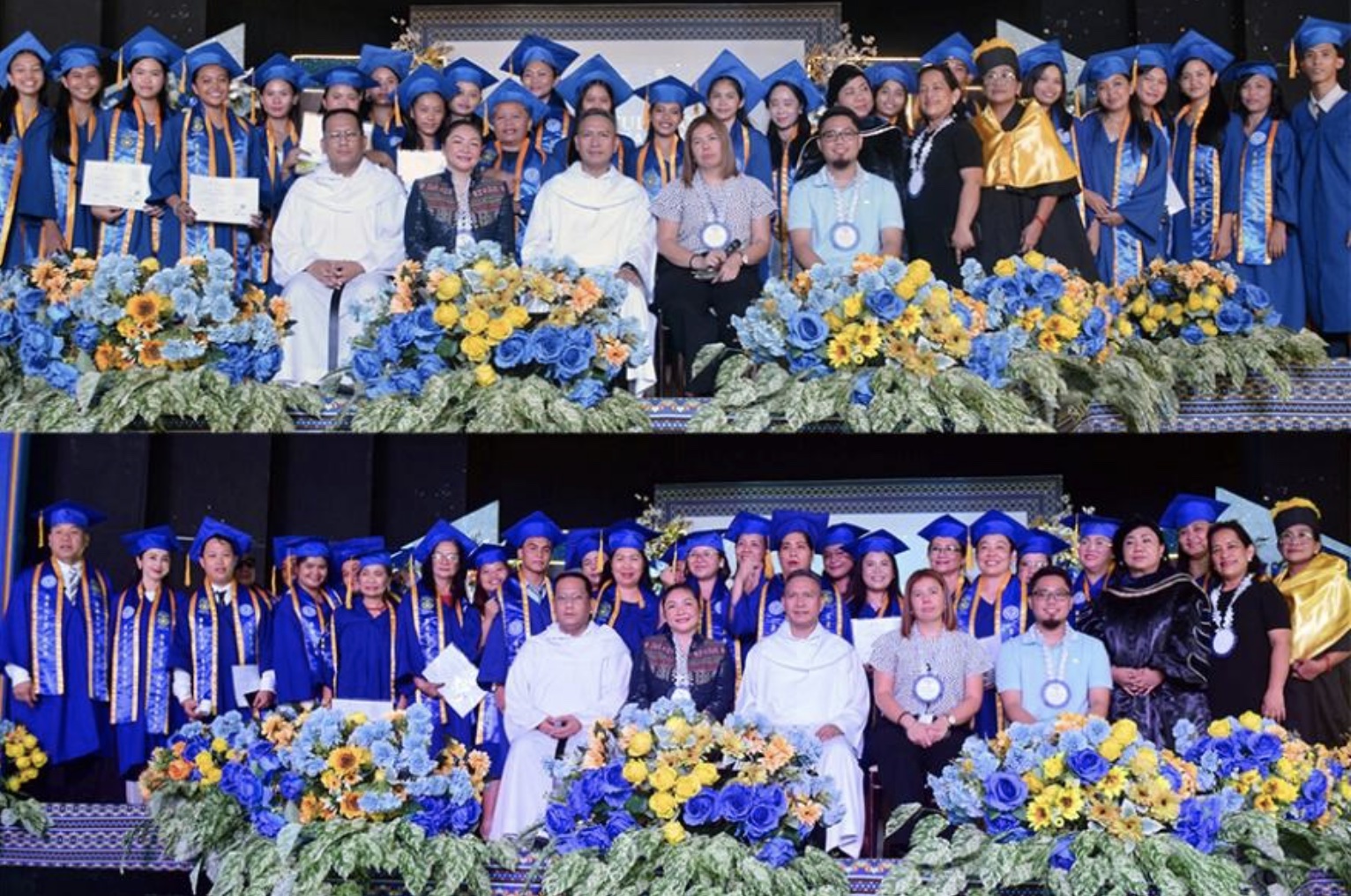
On May 14, 2026, the University of Negros Occidental-Recoletos, Inc. (UNO-R), through its Special Technological and Educational Programs (STEP), marked a historic milestone by holding the 1st Graduation Ceremony for Bread and Pastry Production NC II, sponsored by the Technical Education and Skills Development Authority (TESDA). The momentous event honored the dedication, hard work, and newfound skills of its pioneer batch of graduates, ready to enter the culinary and baking industry. The celebration kicked off at 8 AM with a solemn Thanksgiving Mass presided by Rev. Fr. Ferdinand Fornilos, OAR, at the Oratory of St. Nicholas of Tolentine, setting a reflective and grateful tone for the day, and was immediately followed by the formal graduation program proper at the university auditorium, at around 9 AM.
The ceremony was graced by an esteemed lineup of speakers who offered words of wisdom and encouragement to the graduates. Rev. Fr. Joel A. Alve, OAR, University President, opened the ceremony with a powerful message on resilience and utilizing skills to serve the community. Vice Mayor Angel Gabriel C. Villacin of Talisay City expressed his pride in the graduates and highlighted the local government's support for technical vocational education. Director Niña Connie G. Dodd, Acting Regional Director of TESDA-NIR, delivered the keynote address, emphasizing the high demand for TESDA-certified professionals globally. Meanwhile, Carmeli Bantug Zayco represented and delivered the messages on behalf of Congressman Alfredo Abelardo Benitez of Bacolod Lone District and Congressman Javier Miguel Benitez of the 3rd District. Following the official presentation of candidates by Dr. Nena P. Samillano, STEP Director, Fr. Alve officially conferred the graduates. The graduates did not just walk away with diplomas—they received their official TESDA training certificates and specialized starter tool kits, ensuring they are fully equipped to start their entrepreneurial or employment journeys immediately. The ceremony also shone a spotlight on exceptional performance with the awarding of Special Awards, led by Rev. Fr. Romeo Ben A. Potencio, Jr., OAR, Dr. Samillano, and Ms. Angelic Q. Huyatid.
Representing the voice of the graduating batch, Ms. Dianne Nicole A. Carrera delivered a moving Reflection of the TESDA graduate, thanking the instructors, families, and the institution for unlocking their potential. The event concluded with a heartwarming video presentation, the singing of the TESDA Hymn and the Graduation Song, and a proud recessional march. Moreover, Mr. Kit Martin De Paula served as the master of ceremonies.
Congratulations to the First Batch of Bread and Pastry Production NC II! Your UNO-R family is incredibly proud of you. May your future be as bright and well-crafted as your creations!
Holy Name University commemorated the 150th Anniversary of the Society of the Divine Word (SVD) and honored the birth anniversary of its founder, St. Arnold Janssen, through the solemn dedication of the Immaculate Spouse of the Holy Spirit Church. The church stands as a visible expression of the university’s commitment to nurturing faith.
“Vivat Deus Unus et Trinus in Cordibus Nostris”
The Symbolic Structure: Rooted in the Trinity
The church's triangular form is a symbol of the Holy Trinity, which was at the heart of the spirituality of St. Arnold Janssen. The mystery of the Holy Trinity was expressed through the triangular form of the building. The three sides of the triangle represent the Father, the Son, and the Holy Spirit. Just as the three sides of a triangle are inseparable and form one figure, the Triune God invites all people into a communion of love and unity. The upward point of the triangle also reminds us that our lives and mission are directed to the Father who is the principal rest of the Blessed Trinity to whom all are to return.
Beyond its symbolism, the architect intended the structure itself to become an expression of prayer. The church's triangular form creates the silhouette of a person's arms and hands clasped in prayer, transforming the building into a quiet gesture of worship that welcomes every person who enters.
In the stained glass above the nave, the Holy Spirit appears as a dove hovering over those gathered in prayer, a quiet sign of God’s nearness and promise fulfilled. Like the dove sent out by Noah; first returning in patient waiting, then bearing an olive branch of peace, and finally going forth in the renewed world, becomes a symbol of hopeful expectation and answered promise. The Holy Spirit is not distant or abstract but rests upon God’s people, the same way He descended upon Christ and remained. When Scripture says the Spirit came “like a dove”, it is not trying to describe what the spirit looked like, but how He came: in a way that brings rest and assurance. From above the sanctuary, this image gathers the faithful beneath a living assurance: God is with you, and His presence remains.
The symbolism of the church is matched by its architectural experience. The architect noted that the diagonal lines create a sense of movement that signifies continuity and hope in all aspects of life. This vision is carried through the church's expansive interior, where natural light, open spaces, and unobstructed sightlines create what he described as a dignified and welcoming space conducive to prayer and liturgical celebrations.
"We hope to have achieved a sense of timelessness in the design of the church. This is the church of our time, built with the same devotion, reverence, and quiet grandeur of the past, with design elements that resonate with a modern generation."
- Ar. Rodolfo P. Ventura, MSc, FPIA, Principal Architect, C.A. Ventura and Partners; Dean, University of Santo Tomas College of Architecture
The Holy Spirit and the Immaculate Heart of Mary
The name Immaculate Spouse of the Holy Spirit embodies the relationship between the Blessed Virgin Mary and the Holy Spirit in the mystery of salvation. Her response to God's call "Behold, I am the handmaid of the Lord; let it be done to me according to your word" (Luke 1:38).
Mary, as the Immaculate Spouse of the Holy Spirit, holds a unique place within the mystery of the Most Holy Trinity, for her Immaculate Heart is completely united with the divine will of the Father, the Son, and of the Holy Spirit. Through the Holy Spirit, she was filled with grace and made the perfect dwelling place of God, and in her maternal love she continues to lead souls into deeper communion with the Triune God.
In calling upon Mary, we are never separated from the Holy Spirit, for her whole being is formed and moved by Him who entrusted to her the distribution of graces according to God’s will. Thus, the Immaculate Heart of Mary becomes a pathway to the Holy Trinity, drawing us to the Father as our ultimate fulfillment, to the Son as our Redeemer, and the Holy Spirit as the source of all sanctification; so that, through her, we may be transformed into living reflections of divine love.
Ad Finem
Since its dedication, the Immaculate Spouse of the Holy Spirit Church has become a sacred center of worship, reflection, and community life. It serves as a gathering place where students, faculty, staff, alumni, and visitors come together for prayer, liturgical celebrations, and spiritual reflection. Daily Masses are celebrated from Monday to Saturday at 12:00 noon, while Sunday Mass is held at 10:30 a.m., providing regular opportunities for communal worship and faith formation. The Sacrament of Reconciliation is available 30 minutes before the daily 12:00 noon Mass, from Monday to Saturday.
As a sacred dwelling of prayer and grace, the Immaculate Spouse of the Holy Spirit Church stands as a reminder of God’s presence among His people. Rooted in the mystery of the Most Holy Trinity and under the patronage of Mary, the Immaculate Spouse of the Holy Spirit, it invites all who enter to grow in faith, prayer, and communion with God.
In Deum
Throughout the academic year, Holy Name University offers recollections for both Integrated Basic Education Department (IBED) and tertiary students, providing opportunities for reflection, discernment, and spiritual growth. Retreat programs for graduating students help them prepare for the next stage of life while carrying forward the values and formation they have received at the university.
Faculty and staff are likewise encouraged to deepen their faith through the annual Employees’ Retreat and other formation programs. Initiatives such as the Arnold Janssen Spirituality Seminar foster a deeper appreciation of the life, mission, and spirituality of St. Arnold Janssen, Father and founder of the Society of the Divine Word. Advent and Lenten Recollection are likewise introduced to all employees to keep them abreast to the liturgical seasons.
The church also serves as a venue for community building activities, including One University in Prayer and Worship Fest, which promote unity and active participation among students and the wider university community.
Looking ahead, Holy Name University will host the National Conference on Catechesis and Religious Education (NCCRE) in April 2027, bringing together educators, catechists, and faith leaders from across the country and further strengthening the university’s commitment to religious education, evangelization, and faith formation.
From moments of prayer and worship to formation programs, outreach initiatives, and national gatherings, every undertaking reflects Holy Name University's commitment to LOVE; Liturgical Activities, Organizational Outreach, Vocation Animation Activities, and Educational Pastoral, forming a university community rooted in faith, inspired by mission, and dedicated to serving God and others.