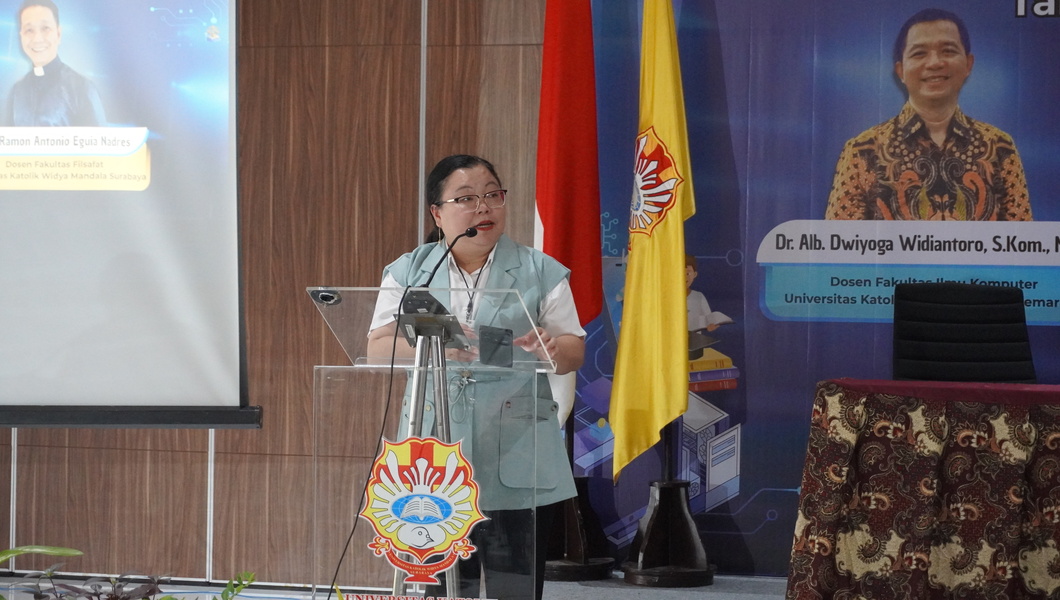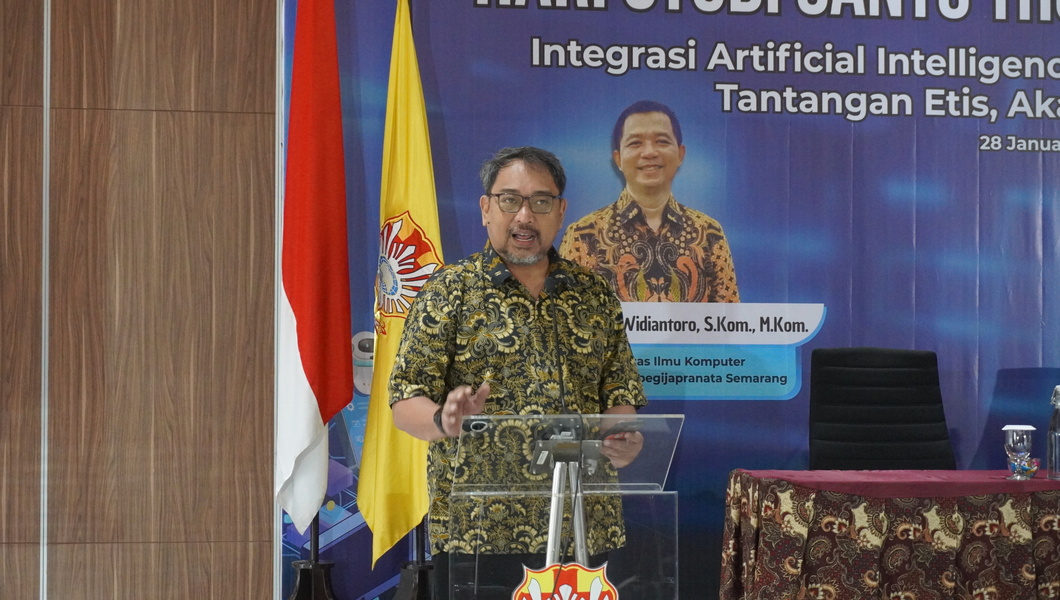
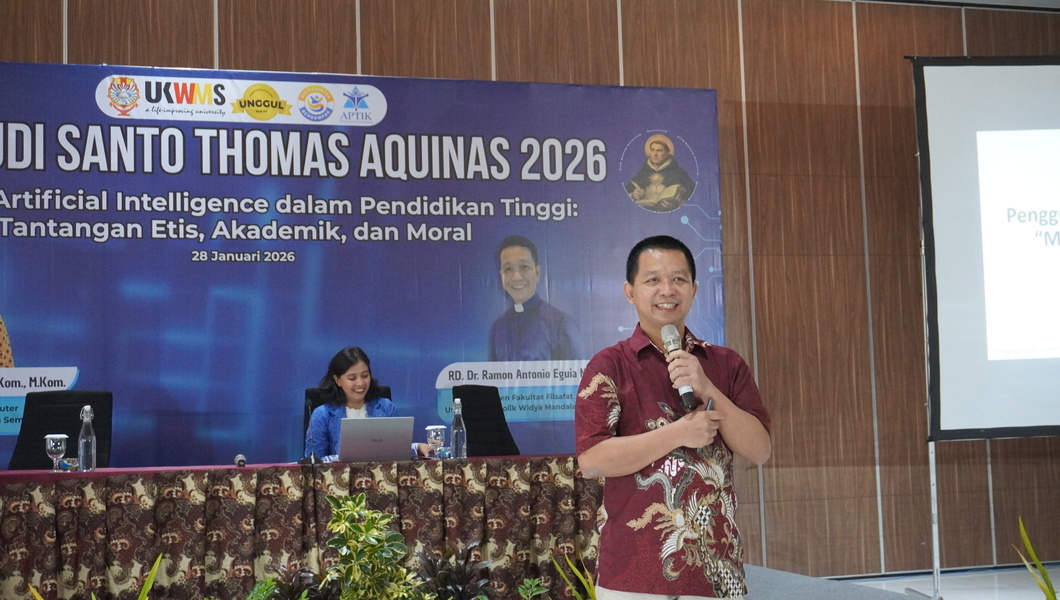
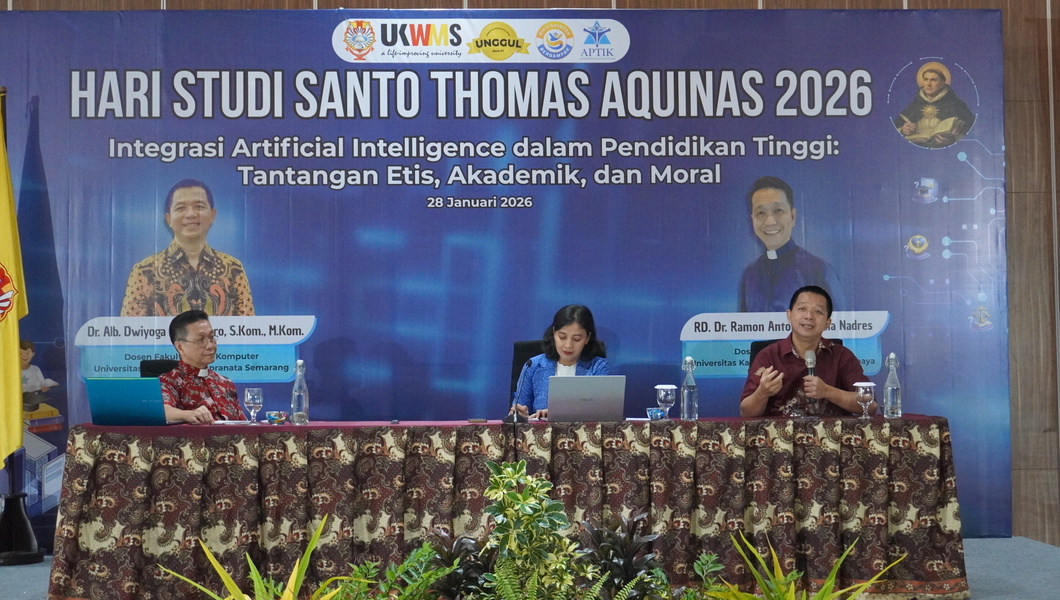
Universitas Katolik Widya Mandala Surabaya (UKWMS) had once again reaffirmed its commitment to addressing the challenges of technological advancement. The effort took form when UKWMS was hosting the 2026 St. Thomas Aquinas Study Day, with “Integrating Artificial Intelligence into Higher Education: Ethical, Academic, and Moral Challenges” as its theme. The event took place on Wednesday, 28 January 2026, in Widya Manggala Room at UKWMS Pakuwon City Campus.
The event featured speakers from various fields of information technology, philosophy, and theology, ensuring a comprehensive discussion ranging from technical to moral perspectives. The speakers were Dr. Alb. Dwiyoga Widiantoro, S.Kom., M.Kom., a lecturer from the Faculty of Computer Science of Soegijapranata Catholic University, Indonesia, and Rev. Dr. Ramon Antonio Eguia Nadres, a lecturer from the Faculty of Philosophy of UKWMS.
This annual academic forum was organized by the Institute for the University Values Strengthening Institute of UKWMS. The event was attended by deans, faculty leaders, heads of study programs, representative lecturers, and heads of work units within UKWMS Surabaya and Madiun, as well as lecturers from the Association of Catholic Higher Education Institutions (APTIK).
The Head of LPNU UKWMS, Dr. Aloysius Widyawan, stated that the development of Artificial Intelligence (AI), particularly generative AI, has brought major changes to the world of higher education. “AI provides great opportunities in learning, research, and administration. On the other hand, it also presents serious challenges related to ethics, academic integrity, and human values,” he said.
Through the 2026 St. Thomas Aquinas Study Day, UKWMS invited lecturers and academic leaders to understand the latest developments in AI technology, identify its benefits and risks, and formulate attitudes and guidelines for its wise and responsible use.
“AI has currently undergone significant development and is becoming increasingly widespread. Even without human intervention, AI can operate and generate the materials we need. However, it becomes a challenge for us not to depend entirely on AI; instead, we must make AI ‘tired’ with the narratives or commands we provide,” said Yoga—as Dwiyoga is familiarly called.
Besides the challenges, there are ethics and morals that must be considered when using AI. “As lecturers, we must be able to guide our students, teach ethics, and use AI wisely in accordance with morals. AI will never become human, because human intelligence has an embodiment,” explained Father Ramon.
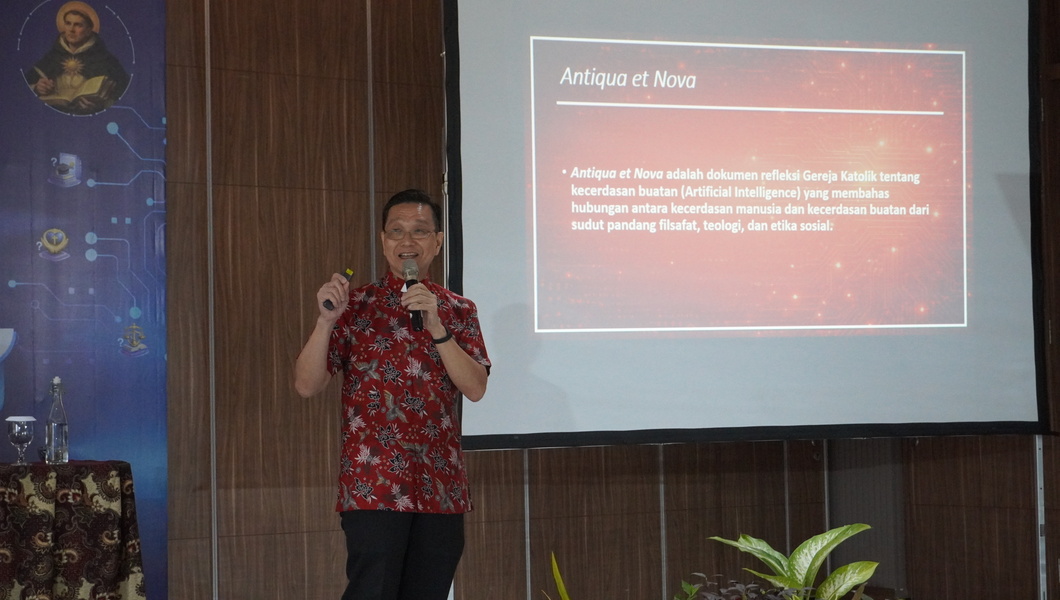
UKWMS Stance on AI
Both speakers agreed that all educational institutions—including UKWMS—cannot avoid facing the onslaught of AI. AI however, is not a replacement for humans, but rather a tool for information and performance support. Undeniably, AI also has its limitations. And we, as humans must also be able to keep up.
The Rector of UKWMS, apt. Sumi Wijaya, S.Si., Ph.D., emphasized that the integration of AI on campus must always be aligned with Catholic values, which uphold human dignity, truth, and moral responsibility. “Technology must serve as a means for holistic human development, not replace human roles and values. We must also be able to utilize AI effectively,” she stressed.
UKWMS also hopes to be a trailblazer in developing ethical, humanistic, and value-based AI utilization policies in higher education. The 2026 St. Thomas Aquinas Study Day serves as a collective space for shared reflection to deliver creative, innovative, and morally grounded higher education in the digital age.